Playground · Docs · GitHub
Go + JSONata = Gnata / Gnata + SQLite = Gnata-SQLite
Recently, RecoLabs made the front page of Hacker News with “Saving $500K/yr” by rewriting JSONata from JavaScript to Go with AI. They outline turning an agent loose for 7 hours and $400 in tokens to produce 13,000 lines of Go passing all 1,778 official JSONata test cases-starting with the full test suite, then the rest of the codebase.
A static, simple language like Go appears to be a great fit for LLMs. Type errors are caught before runtime, simplicity reduces context blind spots, and the result is a fast executable with far lower memory requirements than a JavaScript runtime.
The project also introduced me to JSONata. The dev community has been jaded by end-all query languages like GraphQL. JSONata, by contrast, is simple yet expressive - users can do a lot with a little when querying JSON objects. It makes a strong enhancement to any app that needs user-facing data queries, even if it shouldn’t be the foundation of an API or RPC layer.
Join my email list for updates
The problem: user-defined queries in SQL
This clicked for me. A current project had just implemented a way to let users write the SELECT part of a SQL statement. It was a prototype and not fit for production, mainly because of security and correctness issues. The approach was interesting: it takes the SELECT statement and evaluates it within the same query. This avoids DB-to-code round trips and pushes logic into the data layer, making usage across services simpler.
JSONata is a natural replacement for that clunky prototype. It is safe from injection and sealed to its own execution context, which keeps access controlled.
Bridging Go and SQLite
Using cgo and SQLite’s extension system, integrating Go with SQLite is straightforward. An expression like Account.Order.Product can reach into nested JSON stored in a column and pull exactly what you need-no extra parsing, no round trips.
Per-row transforms with jsonata():
SELECT jsonata('title & " (" & $string(year) & ")"', data) FROM books;
"Dune (1965)"
"Neuromancer (1984)"
"Snow Crash (1992)"
Aggregate across rows with jsonata_query() - build a full dashboard in a single expression:
SELECT jsonata_query('{
  "purchases":    $count($filter($, function($v){$v.action = "purchase"})),
  "revenue":      $sum($filter($, function($v){$v.action = "purchase"}).amount),
  "refunds":      $sum($filter($, function($v){$v.action = "refund"}).amount),
  "users":        $count($distinct(user)),
  "avg_purchase": $round($average($filter($, function($v){$v.action = "purchase"}).amount), 2)
}', data) FROM events;
{
  "purchases": 20000,
  "revenue": 6808900,
  "refunds": -1015000,
  "users": 200,
  "avg_purchase": 340.45
}
A tiny LSP for the browser
For the end-user experience, a rich editor was essential: schema awareness, hover hints, and autocomplete. Because of the size of the full Go implementation and potential speed issues, TinyGo was the right choice. It produces a much smaller binary at the cost of fewer runtime features. Here, it is a perfect fit: a WASM LSP with a 145 KB gzipped footprint.
The LSP can also plug into backend endpoints for autocomplete schema data. This allows the schema to be fetched from the server rather than shipped to the client.
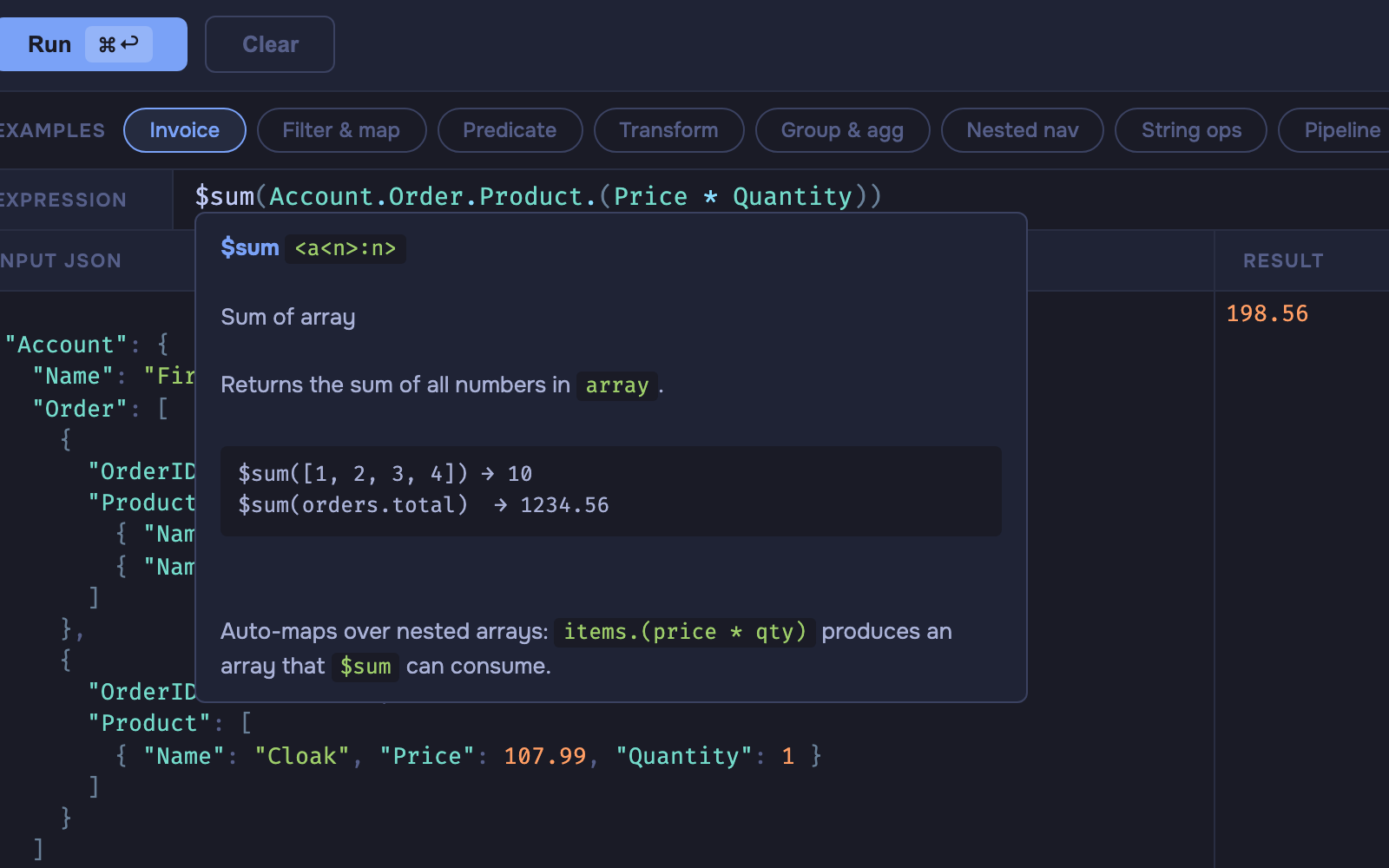
Hover hints surface documentation inline - $sum, $filter, $map, and every built-in function:
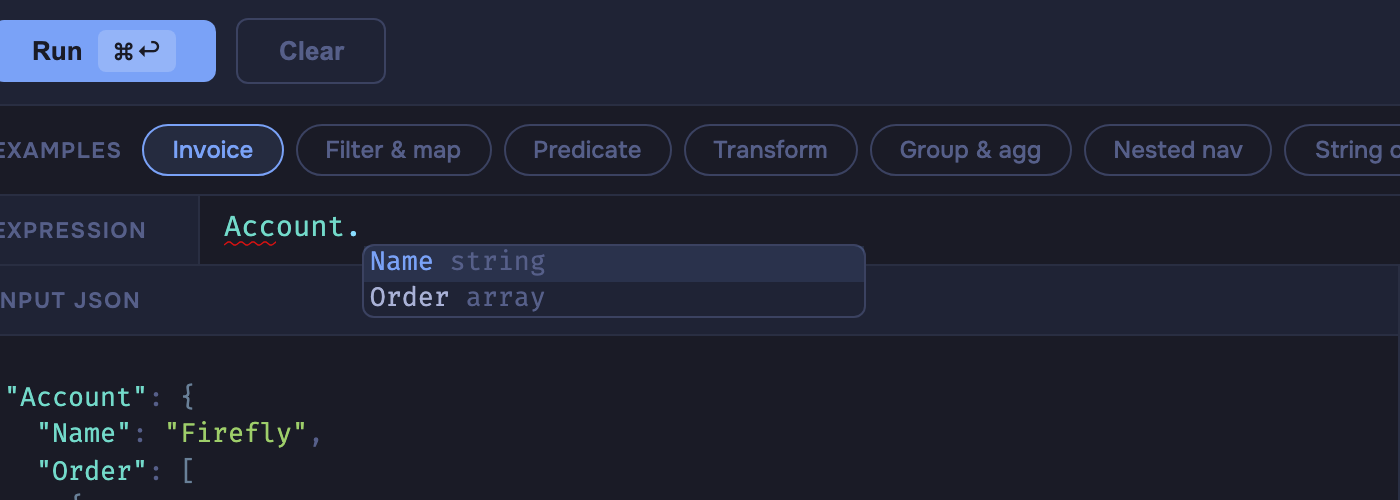
Autocomplete is schema-aware - dot into a field and see its children with types:
CodeMirror + React = drop-in editor (the fun part)
CodeMirror is a great fit here: a fast browser editor where you add features as needed-autocomplete, linting, and documentation hints. The @gnata-sqlite/codemirror and @gnata-sqlite/react packages make integration straightforward.
Having a rich editing experience is essential to frictionless user queries. The goal is to make it easy and fun to explore data with JSONata, without needing to read docs or remember function signatures. The editor does the heavy lifting, so users can focus on asking questions of their data - FUN
The optimizer: streaming vs accumulating
The naive way to implement jsonata_query is to buffer every row, build an array, and hand it to the JSONata evaluator. That works, but it’s 439ms on 100K rows and scales linearly in memory - every row lives in a Go slice until the expression finishes.
The current implementation does something different. At compile time, a query planner walks the JSONata AST and decomposes it into streaming accumulators - each one processes rows individually in constant memory, then the final result is assembled once after the last row. One table scan, one GJSON parse per row for all fields, O(1) memory.
The result: 83ms - matching hand-optimized single-scan SQL (84ms) on the same 5-aggregate report.
The planner borrows ideas from engines that have solved this before: DuckDB’s batch JSON shredding (extract all fields in one parse), ClickHouse’s -If combinator (identical predicates evaluated once per row and shared across accumulators), Spark Catalyst’s constant folding ($sum(amount * 1.1) becomes $sum(amount) * 1.1), and Postgres-style common subexpression elimination.
But not everything can stream. $sort, $reduce, and $map over the full row set require all rows in memory - there’s no way around it. An expression that stays on the streaming path scales to millions of rows; one that falls back to accumulation hits a wall. The optimizing queries guide covers what streams, what doesn’t, and how to stay on the fast path.
The result
The result is a full-featured toolkit that makes adding powerful query capabilities to any app easy. Thanks to RecoLabs’ work, there is now a solid Go JSONata implementation, and Gnata-SQLite wraps it in a CodeMirror editor with simple React integration and strong query support.
You can find some benchmarks here, to see how it stacks up against equivalent SQLite queries. Admittedly, some are a little painful. But the goal isn’t to beat hand-optimized SQL - it’s to give users a fun, powerful, flexible way to query their data without needing to write crusty SQL. For that, Gnata-SQLite delivers.
Found a bug? Open an issue.
Want to discuss? GitHub Discussions.